
Maus: A Survivor’s Tale
Presented by: Florentia Antoniou
Maus I: A Survivor’s Tale: My Father Bleeds History (1986) is a versatile work of art; it is a graphic novel, a comic book, a memoir about the Holocaust, and an autobiography about intergenerational trauma and survivor’s guilt; at its core, there is an animal allegory, where Jews are drawn as mice, Germans as cats, Americans as dogs, and Poles as pigs. Since its publication, Maus has baffled critics and readers alike as to its literary form (due to its intimate nature and its unique depiction of the gravity of the Holocaust), so much so that even the Pulitzer Prize committee created a special category to honour it. Maus was awarded the Pulitzer Prize in 1992 and it is the first graphic novel to have ever received the award.
Art Spiegelman was born on February 15th 1948 in Stockholm; his parents, Vladek and Anja, both Auschwitz survivors, abandoned Poland at the end of WWII and emigrated to Sweden before settling in the US in 1951. Although the Spiegelmans physically escaped the Holocaust (their friends and families did not), their household was plagued by ghosts of all that they had lived in the past; Spiegelman’s “father would wake up nights screaming, while his mother took sleeping pills for her insomnia” and they “both hid the tattooed numbers on their arms” (Heer 34).
From very early on, Spiegelman found solace in comics, they offered him escapism. Throughout the years, his parents shared stories with him of wartime traumas, for which he had no context at such a young age, that left a lasting scar on his psyche. In 1968, at age 20, Spiegelman was hospitalized for a month due to a mental breakdown and soon after his release his mother took her own life leaving no note behind. As Heer writes: “The guilt and mutual recrimination after Anja’s suicide further poisoned Spiegelman’s relationship with Vladek” (34). All these events irreparably influenced the nature of his comic creations.
Maus is a collage of flashbacks; it shifts throughout between the past and the present, between Vladek’s experiences in Poland as a young man, before and during WWII, and the narration of his memories as an old man, and all the while, the readers also follow Spiegelman’s creative process and internal turmoil. Maus is as much a story about a tortured father-son relationship as it is an eyewitness account of the Holocaust.
In the panels that dwell in the past, Vladek tells Art about his life in the 1930s, how he met Anja and how they had their firstborn son, Richieu (who did not survive the war). Once WWII began, the couple continuously played cat and mouse with the Germans and successfully managed to escape capture. At the end of Volume I, however, the two are caught and sent to Auschwitz. Their experiences in the death camp and their eventual reunion as well as Richieu’s death and Art’s sibling rivalry with his dead brother are depicted in the second part; Maus II: A Survivor’s Tale: And Here My Troubles Began (1991).
In the panels that dwell in the present, Spiegelman does not romanticize his father, himself, or their strained relationship. Vladek is deeply scarred by all the traumas of his past; he is stingy, neurotic, emotionally manipulative and obsessed with order. Art is sarcastic, impatient and bitter; he often yells at his father, and cares more about finding out every little detail of Vladek’s WWII past than he cares about his father’s wellbeing in the present moment. Spiegelman presents to the readers a raw, realistic self-portrait: his unfiltered guilt, his conflicted sense of self, and his creative self-doubts.
To bring Maus to life, Spiegelman recorded more than forty hours of taped interviews with his father, which are often deeply personal in nature; Spiegelman wished to tell his father’s story “the way it really happened” (I.23). The interviews are a mirror-image of the troubled father-son relationship; the process was emotionally draining for both of them. While researching his parents’ pasts, Spiegelman also visited the concentration camp Auschwitz-Birkenau.
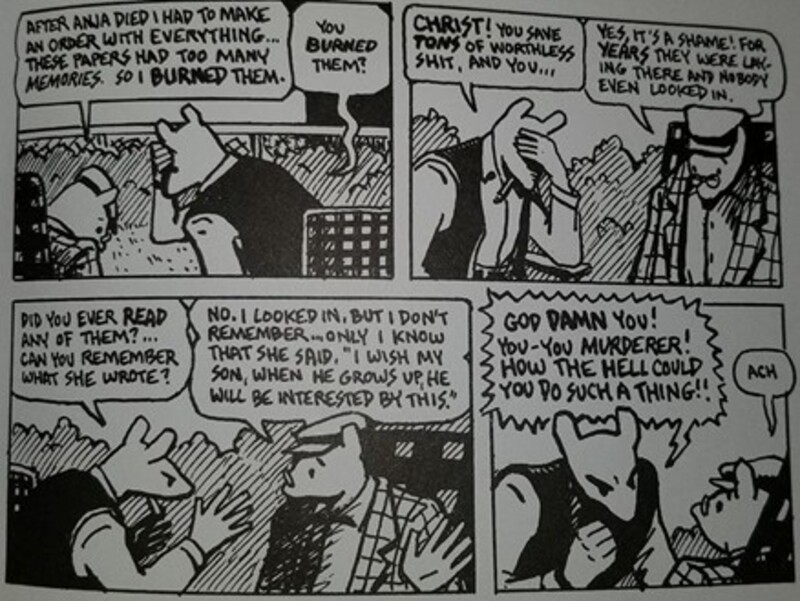
Maus is also a collage of memories, those of Vladek and Art. Anja’s missing memories and silenced voice hang over Maus like a dark cloud. Anja is only always reflected through the memories of her husband and son. As Hirsch (418) writes: “Anja is a silent presence in the text, yet one that “dominates” every part of Spiegelman’s carefully constructed narrative” (cited in Ricks 82). Anja kept diaries throughout her experiences at Auschwitz, which she later rewrote after she survived and the originals were lost; her diaries were her identity, her memories, her story and her voice from a time that her life was completely out of her control.
Art repeatedly begs Vladek to share Anja’s diaries with him, but he keeps evading the requests. At the very end of Volume I, Vladek confesses that he has destroyed the diaries by burning them in a fit of depression and Art accuses his father of being a murderer (I.159). Anja’s Holocaust story would have reflected the story of every woman prisoner of Auschwitz and would have also helped Art understand his mother better (and himself, and her loss); and yet, they did not survive her own husband because her memories were too much for him to bear. As Ricks writes: “Like Anja’s absence in Maus’ narrative, millions of Jewish people had their voices silenced in the Holocaust and were unable to testify of their own experiences, requiring their story to be told by the survivors of the tragedy” (83).
References
Heer, Jeet. In Love with Art: Françoise Mouly’s Adventures in Comics with Art Spiegelman. Coach House Books, 2013.
Ricks, Angela. ““Ghosts Hanging over the House”: Anja Spiegelman and Holocaust Memory in Art Spiegelman’s Maus.” Criterion: A Journal of Literary Criticism, vol. 14, no. 1/8, 2021, pp. 81-96.
Spiegelman, Art. Maus I: A Survivor’s Tale: My Father Bleeds History. New York: Pantheon Books, 1992.
LANGUAGE: English
This title was not censored before publishing